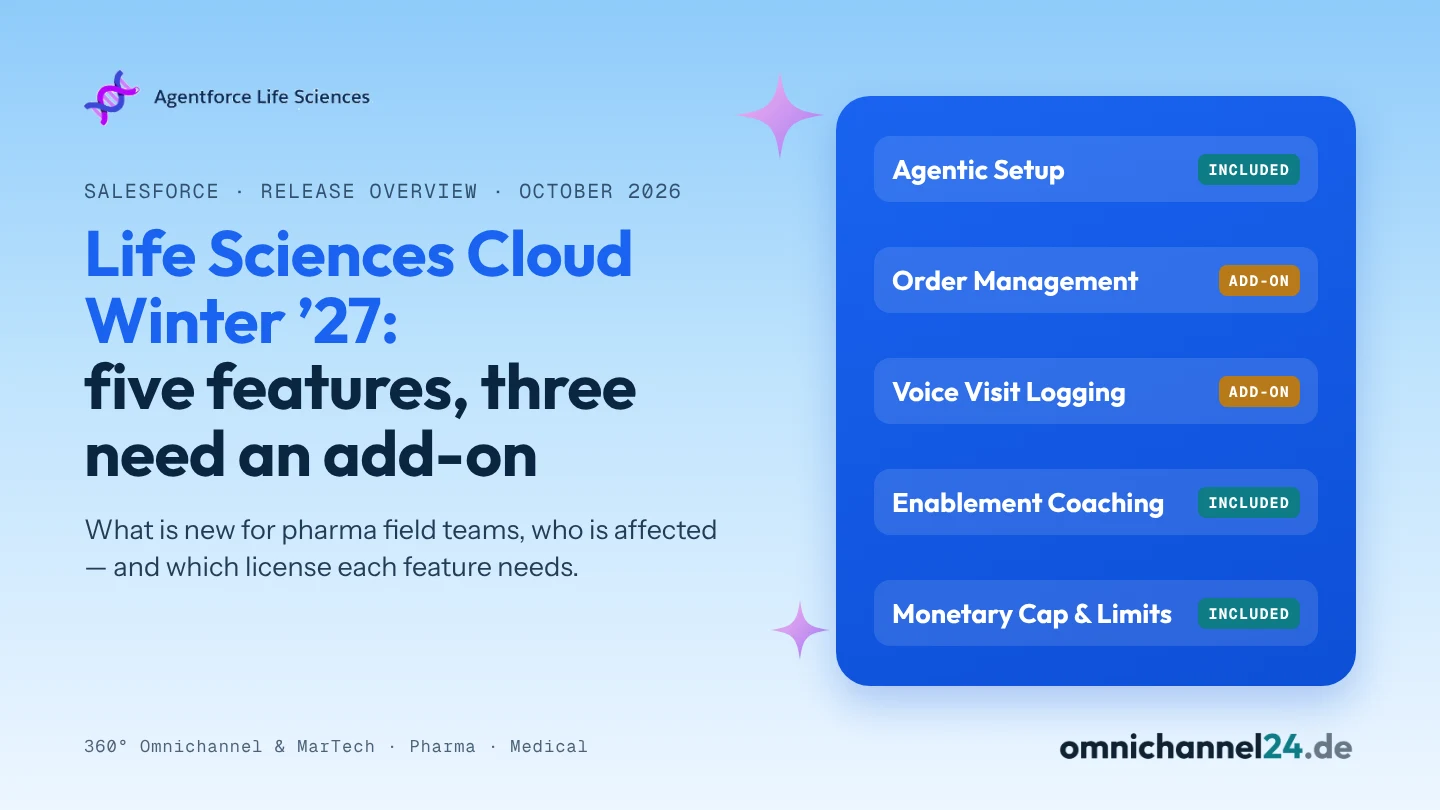
Salesforce’s Winter ’27 release for Life Sciences Cloud has five headline features for pharma field teams. Three of them need a license many field teams don’t own yet. The feature list reads well. The license map is what decides whether the business case still holds.
Life Sciences Cloud is Salesforce’s CRM for pharma and medtech: it plans and records visits to doctors and pharmacies, manages consent, samples and HCP events, and runs on the web and on the iPad. This article walks through what Winter ’27 adds, who in a commercial organization works with each feature, and what to check before you switch anything on.
What shipped, exactly
- Agentic setup. An AI coding agent in Claude Code or Agentforce Vibes takes a package-ready org to a field rep’s first visit: it configures territories and users, deploys the required metadata, creates minimal test data, validates the visit and regenerates the mobile metadata cache. A second workflow sets up Key Account Management, including permission set assignments, stakeholder picklists and standard goals for account plans.
- Order Management. Reps create quoted orders on the web or the iPad, even offline, pre-filled from the last order or an assortment, and capture the signature on site. Pricing procedures calculate prices and discounts centrally, and a price waterfall shows the store manager the net price line by line. Store Check compares what a rep captures in a pharmacy with the store’s targets and flags stock gaps and compliance issues. Setup now sits in one place, Salesforce Go.
- Voice-based visit logging (generally available). Visit Agent turns a rep’s spoken notes into a visit record on the iPad — products, messages, HCP reactions, presentations, place and time — on the device, even without an internet connection. The rep reviews and edits everything before saving.
- Enablement Coaching. Admins build weighted evaluation templates with the Discovery Framework and OmniStudio. Coaches schedule sessions from the calendar, evaluate offline during field rides, link the visits they observed and compare scores with the last evaluation. Available starting September 2026.
- Monetary caps and utilization limits for events. Estimated expenses are now allocated to each participant before the money is spent, and caps are checked the moment an account is added to an event. Attendance limits warn or block when an account would exceed them; a new batch job recalculates utilization counts, and account merges now carry estimated and committed expenses, not only actual ones.
Smaller items in the same release: verbal and paper-based consent proofs, faster data entry in group visits, Twilio remote sessions from the desktop, tracking of email fragments and in-presentation interactions (also as Data 360 data streams), a Content Ingestion API for remediated content from external asset systems, and Tableau Next components on Lightning pages.
What changes, and for whom
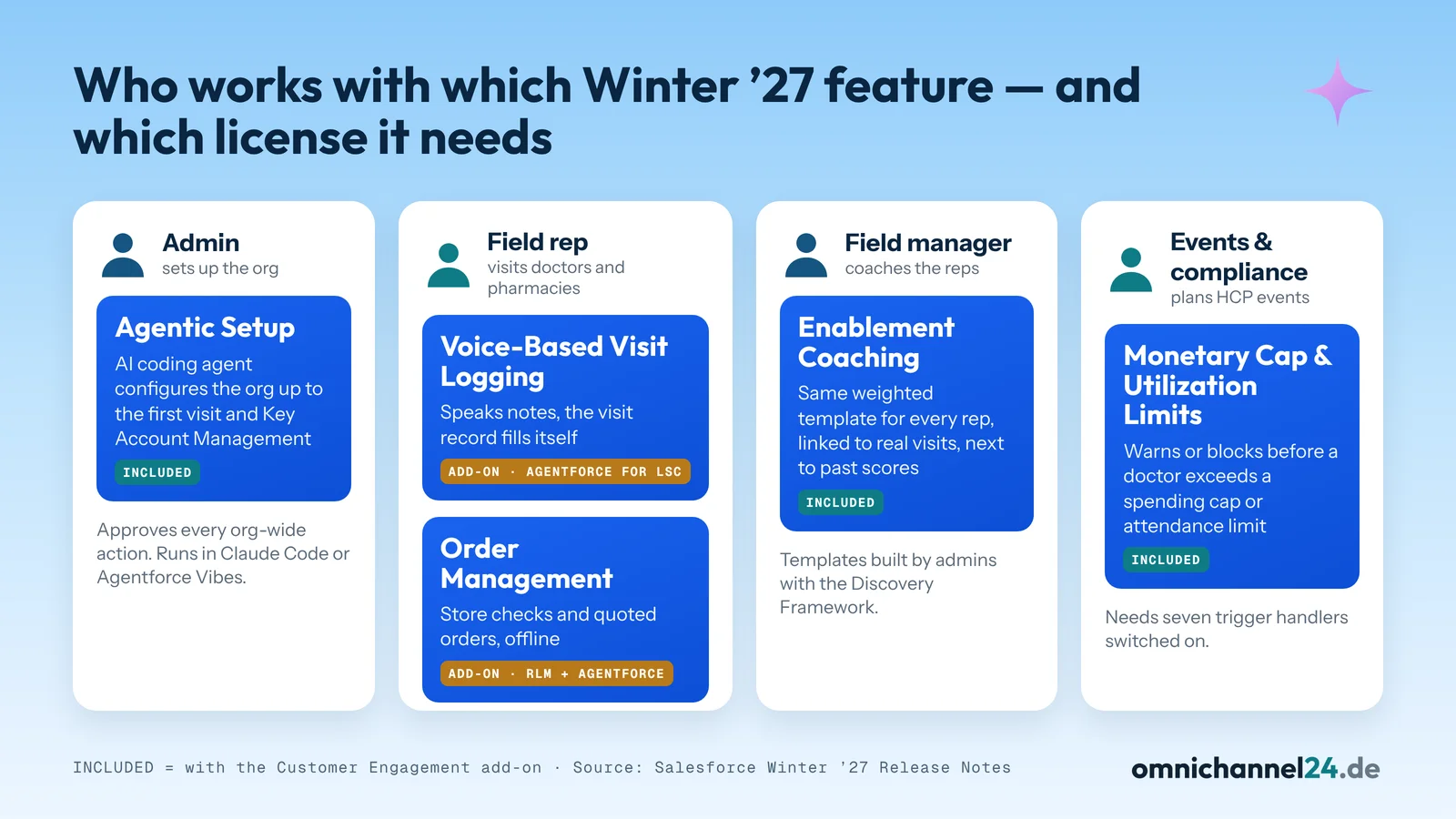
- Admins and implementation partners stop clicking through a long setup checklist. They describe the goal to an agent, then review and approve its proposed metadata deployment, territory activation and user configuration. The work shifts from doing the setup to checking it.
- Field reps stop typing visit reports after each meeting. With Order Management, the pharmacy visit becomes a sales visit: shelf check, quote, signature in one flow on the iPad.
- Field managers get one evaluation standard across regions instead of local forms — with an audit trail of which visits an evaluation is based on.
- Event and compliance teams see a spending or attendance problem before the HCP is invited, not after the invoice arrives. That moves compliance from reporting to prevention.
The architecture behind it
Every feature in this release sits on the same base: the Life Sciences Cloud license, the Life Sciences Cloud for Customer Engagement add-on, the Customer Engagement managed package and Enterprise or Unlimited edition. On top of that base sit two optional layers, and that is where the business case gets decided.
The Agentforce for Life Sciences Cloud add-on is required for voice-based visit logging and for Store Check. The Revenue Lifecycle Management add-on is required for quoted orders, pricing procedures and the central Order Management setup. In October, Salesforce added a disclaimer to the Order Management release note: it includes only Orders and Pricing, and using other Order Management-aligned services such as Billing can increase subscription costs.
The agentic setup is not a button in Setup. It is a set of skills from Salesforce’s skills library on GitHub — life-sciences-fieldsalesrep-coordinate, life-sciences-kam-coordinate, life-sciences-prerequisites-validate and life-sciences-territory-configure — that you add to Claude Code or Agentforce Vibes. The agent asks for explicit approval before any org-wide action, checks record data against the org before submitting changes, and can pause and resume a session. Visit Agent runs speech-to-text on the iPad with a Whisper model the app downloads at login, primed with the territory’s product names to improve accuracy. Monetary caps and utilization limits are configured as Provider Activity Measure Type records and kept consistent by seven new trigger handlers that admins activate in the Admin Console.
The fine print
- Voice-based visit logging works on the iPad only and supports English only. The speech model is about 632 MB, and reps must turn on Apple Intelligence. Pilot users from the previous release need the new Access Custom Agents permission set.
- HCP reactions (positive, negative, neutral) are AI-generated drafts. Salesforce states they are not medical opinions or records of HCP intent and are not used for downstream scoring.
- The agentic setup needs a provisioned org with the managed package and its prerequisites in place. The final check on an enrolled iPad stays manual.
- Monetary caps and attendance limits are set up in the Developer Console; the trigger handlers are not on by default.
- Enablement Coaching admins need the Life Sciences Commercial Admin permission set and the Assessment Platform User permission.
- The Life Sciences release notes are still being updated: several items were added in September and October. Re-check them before planning a rollout.
Questions to settle before switching it on
- Which of the five features does our current license already cover, and which need Agentforce for Life Sciences Cloud or Revenue Lifecycle Management?
- Who reviews and approves what the setup agent proposes — and who owns the org once an agent has configured it?
- Do our field teams outside English-speaking markets get value from voice logging today?
- Does the HCP-reaction draft fit our medical and legal review rules for visit documentation?
- Are our event caps defined per market, so the new estimated-cost checks have real limits to check against?
Winter ’27 makes Life Sciences Cloud more useful in the field and faster to set up. Whether it pays off depends less on the features than on which license layer you are willing to add.
Sources: Salesforce Winter ’27 Release Notes — Life Sciences · Prepare Life Sciences Cloud for a Field Rep’s First Visit · Set Up Key Account Management Faster with an AI Coding Agent · Order Management · Enable Voice-Based Visit Logging (Generally Available) · Enablement Coaching · Monetary Caps · Utilization Limits · Event Management Trigger Handlers. Salesforce, Life Sciences Cloud and Agentforce are trademarks of Salesforce, Inc. This is an independent analysis; no partnership with or endorsement by Salesforce. More on our industry work in pharma and medtech. First published as part of my LinkedIn series, October 2026.